

Ruth Patrick Darlene of WomenSV Exposes Overt and Covert Coercive Control Tactics
Learn how Ruth Patrick Darlene, Founder of WomenSV, exposes common overt and covert coercive control tactics, empowering survivors with tools to recognize and escape abusive relationships.

Coercive control has gained increasing attention in recent years due to the dangers and prevalence of hidden abuse. As Founder and Executive Director of Los Altos based nonprofit WomenSV, Ruth Patrick Darlene specializes in teaching survivors, advocates, and allies how to recognize overt and covert coercive control tactics. WomenSV (Women of Silicon Valley) is dedicated to raising awareness around subtle forms of domestic violence including covert abuse and coercive control.
As a nonprofit educational center, WomenSV is working to shine a light on the early warning signs of coercive control and covert abuse. Ruth Patrick Darlene and WomenSV frequently emphasize that education is an essential part of domestic violence prevention. By learning to recognize the signs of overt and covert coercive control, individuals are better equipped to protect themselves and others from the escalating dangers of abusive relationships.
As part of her mission to make this information more accessible, Ruth Patrick Darlene gives public presentations, conducts trauma-informed training sessions, and distributes educational materials online. She shares videos on social media to teach others how to spot subtle forms of abuse, along with other resources such as WomenSV’s domestic violence advocacy guide focused on covert abuse and coercive control.
In this article, we’ll explore the nature of coercive control, distinguish between overt and covert coercive control tactics, and delve into the specific strategies that Ruth Patrick Darlene and WomenSV have identified as critical to understanding and addressing domestic abuse.
What Is Coercive Control?
Coercive control refers to a deliberate pattern of abusive behaviors designed to intimidate, manipulate, isolate, and control an intimate partner. This form of abuse can manifest in multiple ways, including physical, verbal, emotional, psychological, financial, sexual, and technology-facilitated abuse. What makes coercive control particularly insidious is that it can be overt — easy to spot — or covert, making it much more difficult to identify and prove.
According to Ruth Patrick Darlene, understanding the different forms of coercive control is key to addressing domestic violence. "Learning how to identify the early warning signs of overt and covert coercive control empowers us to quickly recognize red flags and take action," she explains. "Subtle forms of abuse can go unnoticed and unaddressed for long periods of time, which makes this type of behavior especially dangerous."
Although coercive control is not exclusive to any one gender or relationship dynamic, it is predominantly a gender-based crime perpetrated by men against women. A recent study indicated that nearly one in two women will experience coercive control in their lifetime. Coercive control is a particularly dangerous form of domestic violence because it poses a significant lethality risk, even without a prior history of physical abuse.
The absence of forensic evidence often makes coercive control hard to identify and prove, highlighting the need for greater awareness and education. Ruth Patrick Darlene and WomenSV's efforts revolve around making this information more accessible to help survivors and communities recognize the red flags and seek support.
What is Overt Coercive Control?
Overt coercive control refers to behaviors that are aggressive, controlling, threatening, and easily recognizable. These behaviors are often more blatant and can involve both verbal and physical forms of abuse.
Overt coercive control examples:
Overt coercive control can be verbal or physical.
Verbal examples of overt coercive control include direct, explicit threats of harm, especially if the target disobeys or displeases the abuser. Intimidation through fear is a common tactic, like threatening to hunt down or kill a partner if they try to leave or threatening punishment if demands are not met with immediate compliance. Overtly abusive language intended to humiliate, degrade, or control the victim is another hallmark of overt coercive control.
Physical examples of overt coercive control can involve acts of violence such as strangulation, brandishing a weapon, forced sleep deprivation, blocking exits, causing harm to a partner's pet or child, or using dangerous or reckless driving as a form of intimidation.
Ruth Patrick Darlene emphasizes that while overt coercive control is alarming and obvious, its danger lies in how it escalates. "There's that element of strategy, strategic thinking, calculating and cunning that goes into the control," she explains.
Survivors of overt coercive control often find themselves in situations where threats turn into actions, and the abuse intensifies over time. This form of coercion can also evolve into subtler tactics, transitioning from overt abuse to covert abuse.
What is Covert Coercive Control?
Covert coercive control, also known as covert abuse, refers to the use of more subtle tactics to threaten, intimidate, isolate and control. The hidden nature of covert abuse makes it difficult to identify, prove and escape from. Covert abuse often goes unrecognized for long periods of time, causing damage to survivors' mental health and progressing to the point where they feel trapped.
"In this case, what you don't know can hurt you," Ruth warns. "It can do serious damage over time."
While subtle forms of abuse may not be immediately obvious, the impact on survivors' health takes a serious toll. Covert coercive control is particularly dangerous because it erodes the victim’s physical and mental health over time. Survivors of covert coercive control face increased risks of mental and physical health issues, from PTSD and depression to chronic pain and autoimmune diseases.
Covert coercive control examples:
Verbal examples of covert coercive control include psychological manipulation tactics such as gaslighting, veiled or implied threats, and isolating an intimate partner. The abuser may turn their partner’s support system against them, often by spreading lies or twisting the truth to make their partner appear unstable.
Physical examples of covert coercive control include indirect threats, like taking out a weapon to clean it during an argument, and sneaky tactics like secretly hiding a partner's car keys or medication to create a sense of dependence. Technology-facilitated abuse tactics can be used to secretly track phones, hack into social media accounts, or use surveillance cameras to monitor a partner's every move.
Survivors often find themselves questioning their own experiences and reality due to the psychological manipulation they've endured. Ruth Patrick Darlene emphasizes that identifying these subtle tactics early on is a crucial step toward escaping abusive relationships.
The Escalation of Covert Coercive Control Tactics
Covert coercive control, or covert abuse, tends to escalate over time with a pattern of abusive behaviors. As a relationship progresses, and even after it ends, covert abuse tactics may evolve with the abusive partner's increasing desire to exert and maintain control. Recognizing the warning signs early on in a relationship is key to seeking support and safety as soon as possible.
Ruth Patrick Darlene describes covertly abusive relationships as a slippery slope. "If you're in a relationship where the control is incremental, increasing slowly over time, it's much harder to tell the difference between somebody who's trying to help you, someone who's trying to protect you, someone who's concerned about you, somebody who's checking in because they care about you and somebody that is wanting to control you and erode your sense of independence and self esteem over time. Only time will tell."

According to Ruth Patrick Darlene, covert coercive control often follows a predictable cycle that escalates as the relationship progresses. She describes this cycle in three key phases:
1. Early in the Relationship: The "Honeymoon" Phase
At the beginning of an abusive relationship, abusers often engage in love bombing—an overwhelming display of affection that may seem too good to be true. This is often marked by constant communication, grand gestures, and declarations of love that can leave the target feeling special and valued.
However, as time goes on, these behaviors take a darker turn. The constant communication becomes intrusive, and what once seemed like romantic gestures now feels more like stalking. This early phase of covert coercive control is the first step in isolating the victim from their support network.
2. During the Relationship: The Mask Slips
As the relationship progresses, the abuser’s mask begins to slip, and the cycle of abuse becomes more apparent. The following signs may become apparent:
Silent treatment or emotional withdrawal when the abuser’s demands are not met.
Accusations and questioning or “grilling” if texts or calls are not immediately answered.
Financial abuse, restricting a partner’s access to money and resources, increasing their dependence on the abuser.
The abuser may revert to love bombing tactics intermittently to create confusion and keep the victim in a state of cognitive dissonance. This cycle of highs and lows keeps the victim trapped in the cycle of abuse, unsure whether the abuser will revert to their earlier "loving" behavior.
3. After the Relationship: Escalation and Retaliation
Leaving a coercive relationship is one of the most dangerous times for a survivor. Covert abusers often escalate their tactics in an attempt to regain control, using:
Smear campaigns: Spreading false rumors about the survivor to damage their reputation, discredit their words and isolate them from friends and family.
Legal abuse: Using the court system to prolong contact with the victim, such as filing frivolous lawsuits or vexatious litigation.
Technology-facilitated abuse: Harassment through social media, revenge porn, or using hidden cameras and surveillance devices to continue monitoring the victim.
Ruth Patrick Darlene warns that these tactics are often employed after the relationship ends as a way to punish and maintain control over the victim.
Resources for Survivors of Overt and Covert Coercive Control
If this has happened to you or someone you know, there is hope. It is possible to break free from the cycle of abuse and begin a new chapter of safety and freedom. Identifying the abuse is the first step; once the issue has been recognized, the process of seeking support and breaking free can begin.
WomenSV maintains a directory of resources for survivors, which includes information about:
Safety planning: Helping survivors create a personalized plan to protect themselves from further harm.
Educational materials: Offering information on the different types of abuse and how to recognize them.
Support groups for coercive control survivors: Connecting survivors with others who have experienced similar forms of abuse.
Organizations and services: WomenSV's searchable directory of resources provides a list of organizations and resources organized by category and location.
WomenSV also offers training for healthcare providers, law enforcement, and community organizations to help them recognize the signs of covert coercive control and provide trauma-informed care.
To emphasize that it's possible to overcome covert abuse, WomenSV highlights testimonials and success stories shared by survivors. "Living in a world of covert deception and abusive tactics is soul squashing," wrote one survivor, who remarked that after escaping, "I am able to learn to find joy again, self care, and most importantly stop the cycle of violence in raising up the next generation by having peace in our home now."

About Ruth Patrick Darlene:
Ruth Patrick Darlene (also known as Ruth Darlene, Ruth Patrick or Ruth Darlene Patrick) founded WomenSV in 2011. Her advocacy experience serving over 1500 survivors over the past 13 years inspired her efforts to raise awareness around coercive control and covert abuse. Her California domestic violence advocacy and POST certifications further inform her work to teach survivors, communities and providers working in healthcare, law enforcement and education how to recognize and address covert abuse and coercive control.

Family Violence Appellate Project (FVAP) case alert highlights protection for domestic violence survivors
Family Violence Appellate Project (FVAP) case results in protection for domestic violence survivors. Read FVAP's report for valuable information about the Domestic Violence Restraining Order process and pay attention to the practice tips on page 2.
Family Violence Appellate Project (FVAP) shared a case alert that highlights available protection for domestic violence survivors.
The case demonstrates how a Domestic Violence Restraining Order (DVRO) can be obtained for nonphysical forms of abuse such as those involved in covert abuse and coercive control.
Read FVAP's report for valuable information about the Domestic Violence Restraining Order process and pay attention to the practice tips on page 2. You can view the report in the images on this page, or click the button below for a PDF version.
For additional insights and information about this case, read the related article: Angry Post-Divorce Words End Up In Court.


Coercive Control and Covert Abuse Awareness for Church Leadership
This presentation led by Ruth Darlene, Founder and Executive Director of WomenSV, offers essential insights into coercive control and covert abuse. Originally presented to the Menlo Church Ministers, this introduction empowers Christian church leaders to support survivors effectively. The class provides a comprehensive explanation of coercive control, along with trauma-informed tips and resources for recognizing and addressing subtle forms of abuse.
This presentation led by Ruth Darlene, Founder and Executive Director of WomenSV, offers essential insights into coercive control and covert abuse. Originally presented to the Menlo Church Ministers, this introduction empowers Christian church leaders to support survivors effectively. The class provides a comprehensive explanation of coercive control, along with trauma-informed tips and resources for recognizing and addressing subtle forms of abuse.
Video timestamps:
00:00 Introduction
6:10 Domestic violence statistics
8:05 What is coercive control?
24:31 Recognizing abuse survivors and victims
25:11 Impact of DV on survivors
25:55 The covert abuser
27:58 Elder abuse
28:38 Spiritual abuse
30:14 Love and faith
35:29 Supporting survivors
Donate to support education about covert abuse and coercive control!

The Equality Wheel: Healthy vs Abusive Relationships
In this video Ruth Darlene of WomenSV discusses elements of healthy relationships represented in the Equality Wheel and how they differ from abusive relationships.
In this video Ruth Darlene of WomenSV discusses elements of healthy relationships represented in the Equality Wheel and how they differ from abusive relationships.
Examining the differences between healthy and abusive relationships reveals the stark contrast between the two. Abusive relationships have a bizarre tendency to make those involved lose sight of what a normal, healthy relationship looks like. If you've been in an abusive relationship for a long time, it might even be hard to recall what a healthy relationship is supposed to feel like. The Equality Wheel demonstrates elements of a healthy relationship, while the Power and Control Wheel contains elements of an abusive relationship.

Image source: Domestic Abuse Intervention Programs

Understanding Coercive Control California Laws (FC 6320) + the Power and Control Wheel
Ruth Darlene, Founder and Executive Director of WomenSV (Women of Silicon Valley), discusses coercive control as it relates to the Power and Control Wheel and current California law.
Ruth Darlene, Founder and Executive Director of WomenSV, discusses coercive control as it relates to the Power and Control Wheel and current California law (as of the time of this video recorded in March 2024).
The Power and Control Wheel was developed by the Domestic Abuse Intervention Project in Duluth, Minnesota to describe tactics that abusers use on their victims. In this video we discuss how it illustrates elements of coercive control that can be observed in abusive relationships.
Family Code 6320 in California includes coercive control within its definition of disturbing the peace. In California, coercive control is now grounds for a restraining order, which if violated can have criminal consequences for the perpetrator. In this video, Ruth Darlene discusses how FC 6320 recognizes and applies to survivors of coercive control.
Video timestamps:
00:00 The Power and Control Wheel
13:20 Federal definition of domestic violence
14:59 California definition of domestic violence
15:45 Family Code 6320
Disclaimer: The information provided in this video is intended for educational purposes only. WomenSV does not provide legal advice or recommendations.

Covert Abuse and Coercive Control Overview: Part 2
Ruth Darlene, Founder and Executive Director of WomenSV, presents a two-part overview of covert abuse and coercive control. This second video involves a deep dive into the minds of victims, survivors and perpetrators of covert abuse. Ruth explains the impact of covert abuse on survivors and the motives behind perpetrators' behavior. This discussion covers the pathway to freedom for survivors of abuse, from risk assessment to breaking the cycle and starting the healing process.
Ruth Darlene, Founder and Executive Director of WomenSV, presents a two-part overview of covert abuse and coercive control. This second video involves a deep dive into the minds of victims, survivors and perpetrators of covert abuse. Ruth explains the impact of covert abuse on survivors and the motives behind perpetrators' behavior. This discussion covers the pathway to freedom for survivors of abuse, from risk assessment to breaking the cycle and starting the healing process.
Remember to like this video, subscribe and follow us on our other social media channels!
Video timestamps:
0:00 Anyone can be a victim or perpetrator
1:21 What do abuse survivors / victims look like?
5:32 Lovebombing, grooming and manipulation silence intuition
7:13 Trauma has a dissociative effect
9:04 Physical DV breaks bones, covert abuse breaks minds
9:42 When is the right time to leave a covert abuser?
14:31 What does a covert abuser look like?
21:23 The Dark Tetrad
31:03 What motivates a covert abuser?
31:36 Covert threats
42:28 The abuser's M.O.
46:41 WEB Scale
54:27 Pathway to freedom
1:17:21 Mental health recovery after abuse
1:22:19 The importance of self-care
1:25:38 Breaking the cycle of abuse
1:34:29 Examples of self-care
1:46:51 Leaving your comfort zone
1:53:36 Thank you to our community partners

Covert Abuse and Coercive Control Overview: Part 1
Join Ruth Darlene, Founder and Executive Director of WomenSV, for an overview of covert abuse and coercive control. This video provides an introduction to subtle forms of domestic abuse, detailing the differences between overt coercive control and covert abuse.
Join Ruth Darlene, Founder and Executive Director of WomenSV, for an overview of covert abuse and coercive control. This video provides an introduction to subtle forms of domestic abuse, detailing the differences between overt coercive control and covert abuse. Ruth explains the cycle of violence as well as the power and control dynamics involved in coercive control. This discussion also addresses the slippery slope of how abusive relationships begin and escalate over time.
Video timestamps:
00:00 Introduction
2:20 What is domestic violence?
13:19 What is coercive control?
20:11 Overt coercive control
21:52 Covert abuse
29:07 Power and control
1:17:58 The cycle of violence
1:26:12 Abuse and the culture of affluence
1:33:57 The slippery slope of abusive relationships

Deep Dive Into Covert Abuse and Coercive Control for Christian Therapists: Part 2
Ruth Darlene, Founder and Executive Director of WomenSV, presents a training to help Christian therapists understand and support survivors of covert abuse and coercive control. In this second half of the two-part training, Ruth discusses the impact of domestic violence on children and adults, potential hazards of therapeutic intervention with a covert abuser, considerations for providing trauma-informed care to survivors, tips for helping survivors tell their story and resources for assessing situations involving domestic abuse.
Ruth Darlene, Founder and Executive Director of WomenSV, presents a training to help Christian therapists understand and support survivors of covert abuse and coercive control. In this second half of the two-part training, Ruth discusses the impact of domestic violence on children and adults, potential hazards of therapeutic intervention with a covert abuser, considerations for providing trauma-informed care to survivors, tips for helping survivors tell their story and resources for assessing situations involving domestic abuse.
Disclaimer: The information provided in this video is intended for educational purposes only. This training is presented as a trauma-informed informational resource to empower therapists with a deeper understanding of covert abuse and coercive control. Ruth Darlene is an advocate, not a therapist, and WomenSV does not offer or practice therapy.
Video timestamps:
00:00 Introduction
2:42 Impact of DV on children and adults
25:48 Hazards of therapeutic intervention with a covert abuser
43:46 Hazards of couples counseling
46:09 Trauma informed care of survivors
53:21 Helping survivors tell their story
58:38 Self-care

Deep Dive Into Covert Abuse and Coercive Control for Christian Therapists: Part 1
Ruth Darlene, Founder and Executive Director of WomenSV, presents a compassionate perspective that empowers Christian therapists to recognize and support survivors of covert abuse and coercive control. This training video covers the definition and characteristics of covert abuse and coercive control, with true stories to illustrate examples of real-life situations that therapists might encounter with their clients.
Ruth Darlene, Founder and Executive Director of WomenSV, presents a compassionate perspective that empowers Christian therapists to recognize and support survivors of covert abuse and coercive control. This training video covers the definition and characteristics of covert abuse and coercive control, with true stories to illustrate examples of real-life situations that therapists might encounter with their clients.
As you watch, you will gain a deeper understanding of both survivors and perpetrators of subtle forms of abuse. The discussion includes an overview of the Power and Control Wheel, the cycle of violence, lethality risks associated with coercive control, the slippery slope of how abusive relationships escalate over time, societal pressures that often silence survivors and the impacts of domestic violence.
We’ll dive into different types of coercive control, including overt coercive control, covert coercive control, covert abuse, verbal abuse, and various forms of emotional abuse such as gaslighting.
Stick around to the end to hear us talk about navigating the concept of being a good Christian wife while recognizing covert abuse and coercive control. Being a good, kind, loving Christian does not mean you have to tolerate abuse!
Disclaimer: The information provided in this video is intended for educational purposes only. This training is presented as a trauma-informed informational resource to empower therapists with a deeper understanding of covert abuse and coercive control. Ruth Darlene is an advocate, not a therapist, and WomenSV does not offer or practice therapy.
Video timestamps:
00:00 Introduction
5:23 IPV Statistics
7:19 The Equality Wheel
8:21 The Power and Control Wheel
9:43 The cycle of violence
12:57 Domestic violence definition
14:34 Family Code 6320
16:29 Coercive control definition
25:48 Overt coercive control - verbal
27:14 Overt coercive control - physical
28:53 Covert coercive control
32:54 Covert threats
38:09 Gaslighting
38:30 The slippery slope of abusive relationships
39:22 DV in affluent areas
40:05 Recognizing and understanding survivors / victims of DV
43:58 Impact of DV on survivors
48:36 Recognizing and understanding perpetrators of DV
53:11 Abuse is the opposite of love
54:34 Q+A

The mental impact of dealing with covert abuse
In this video Ruth Darlene, Founder and Executive Director of WomenSV, shares insights on the mental impact of dealing with covert abuse. An empowering new perspective can be a helpful tool to start moving forward on the healing journey: Wait, Watch, Plan, Jump. Let this be your reminder to slow down, pause when you need to, and move forward with intention when you are ready.
In this video Ruth Darlene, Founder and Executive Director of WomenSV, shares insights on the mental impact of dealing with covert abuse. Traumatic experiences can wreak havoc on a survivor's nervous system, eliciting a flight, fight, freeze or fawn response. When this happens, an empowering new perspective can be a helpful tool to start moving forward on the healing journey: Wait, Watch, Plan, Jump. Let this be your reminder to slow down, pause when you need to, and move forward with intention when you are ready.

Covert abuse and the monopolization of perception
Join Ruth Darlene, the Founder and Executive Director of WomenSV, as she explains the lasting impact of monopolization of perception on covert abuse survivors, illuminating the path to reclaiming freedom.
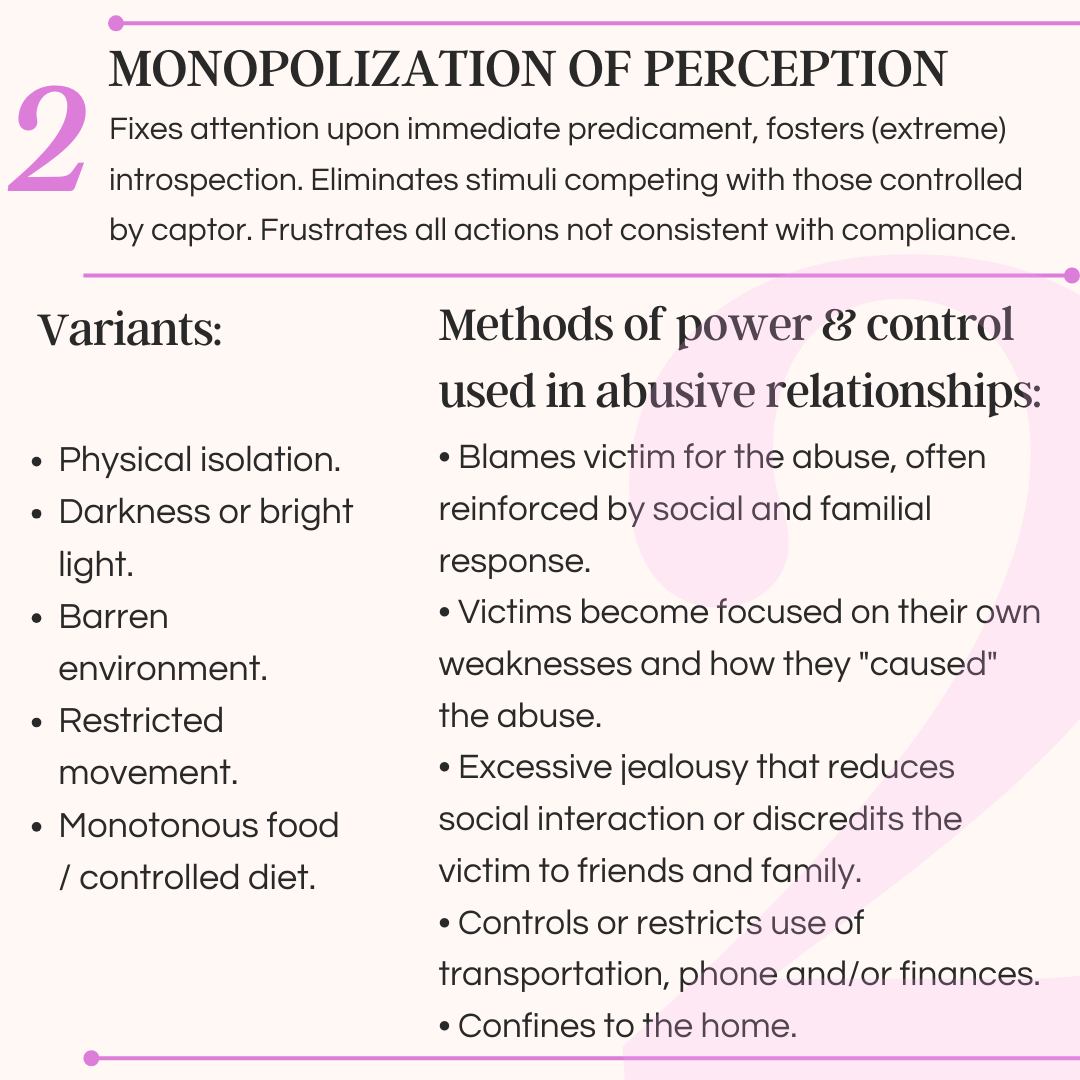
Monopolization of perception is a sinister tactic employed by covert abusers to isolate and dominate their targets, manipulating focus onto themselves. Even after the relationship ends, survivors of covert abuse and coercive control may find themselves ensnared in the abuser's attempts to prevent them from moving on.
Join Ruth Darlene, the Founder and Executive Director of WomenSV, as she explains the lasting impact of monopolization of perception on survivors, illuminating the path to reclaiming freedom.
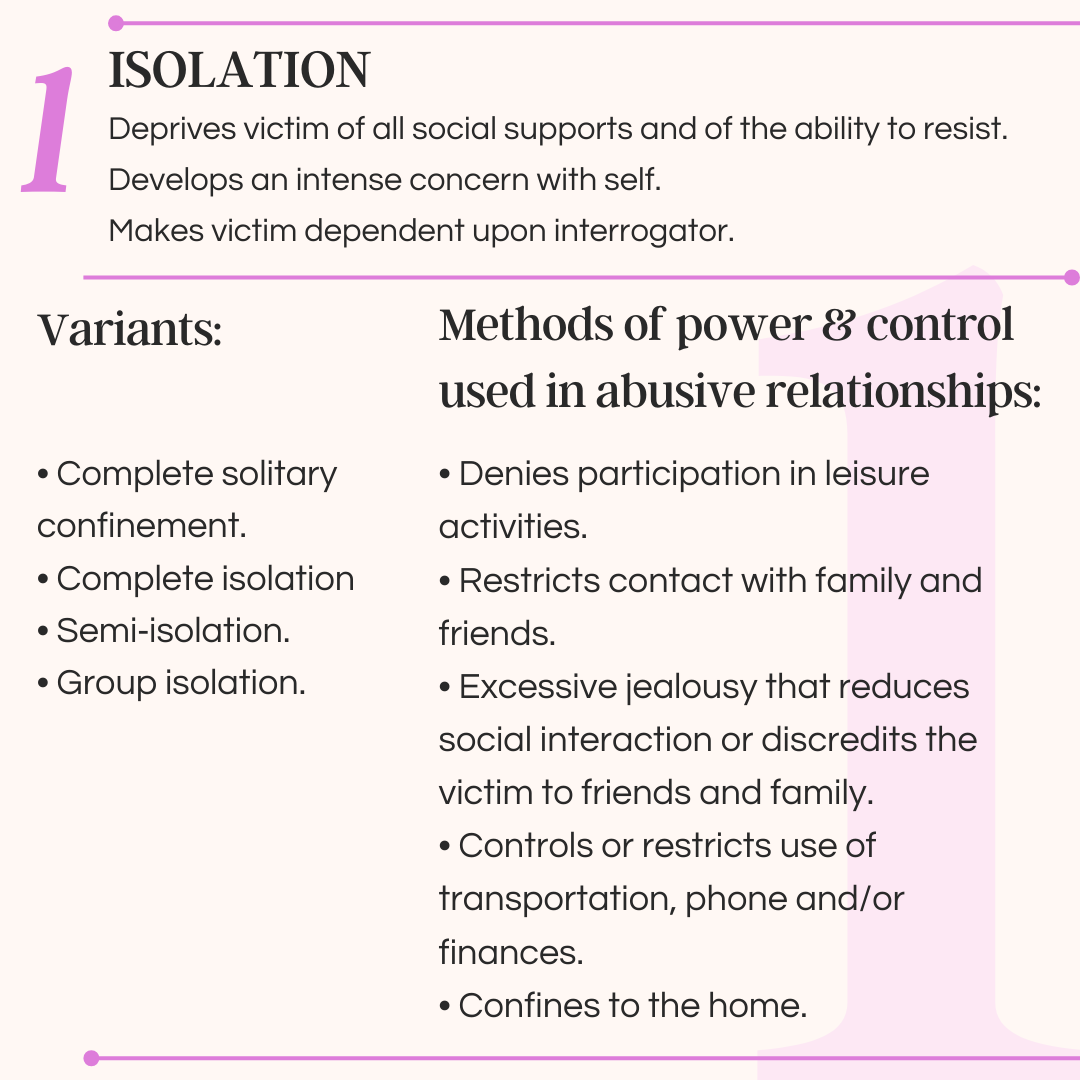
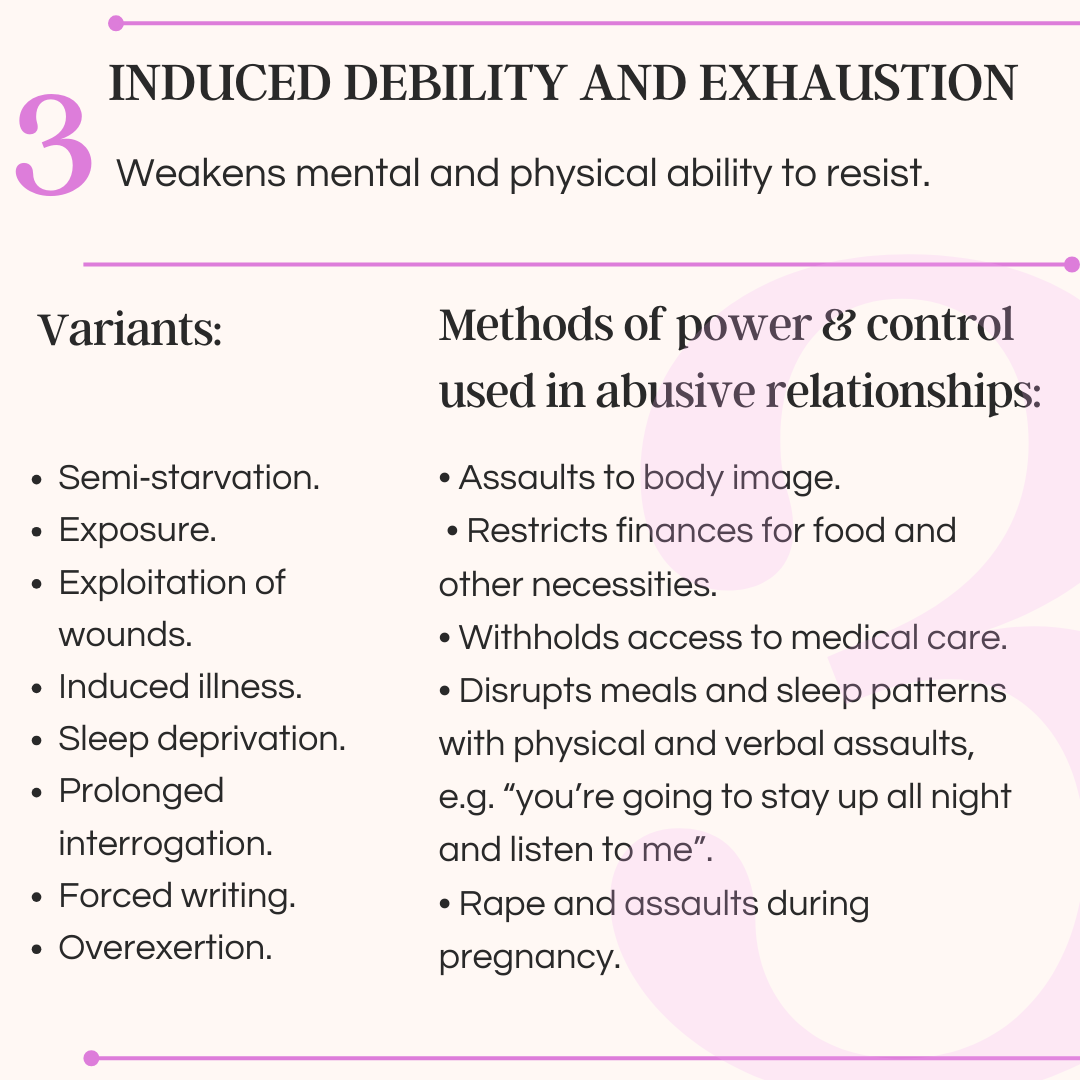
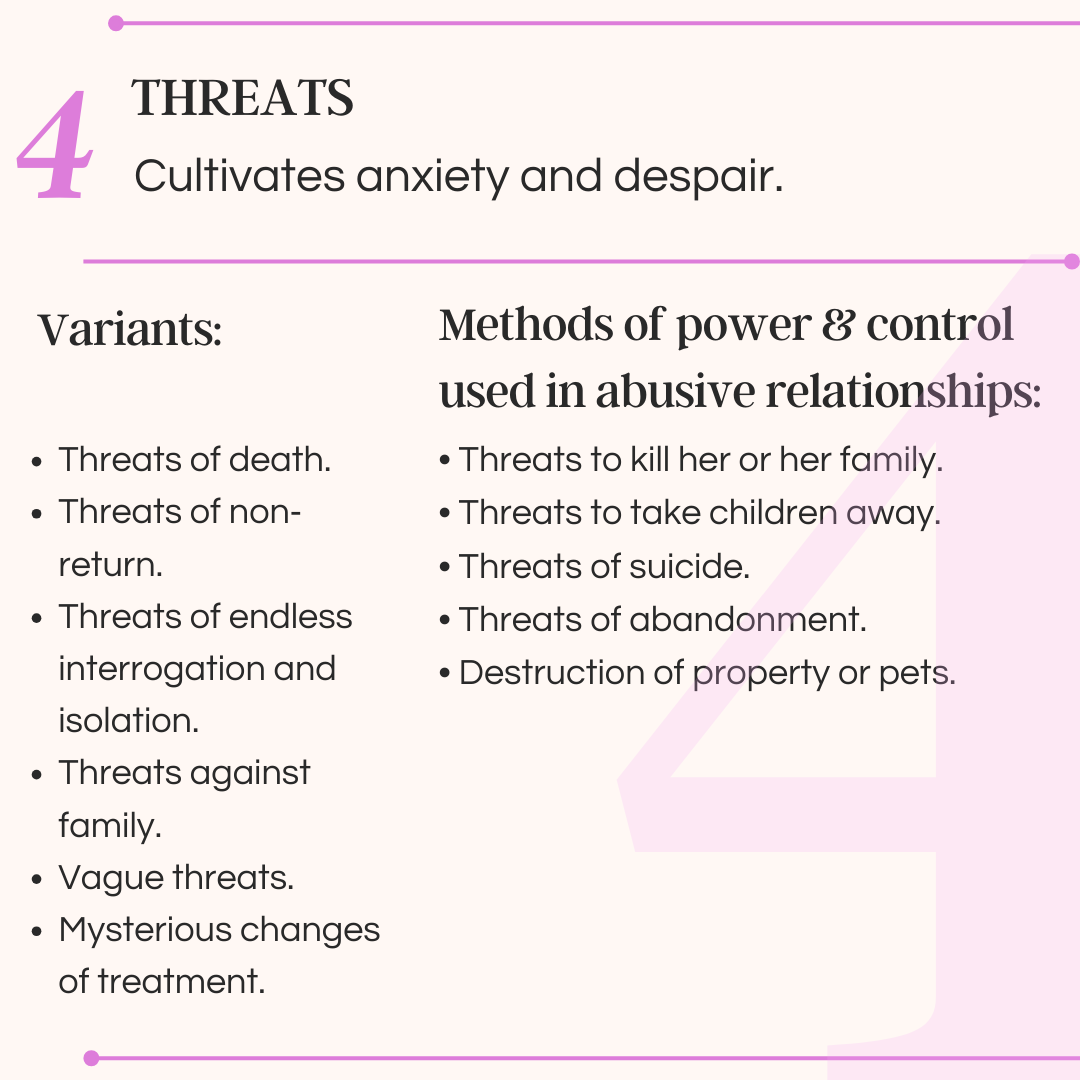
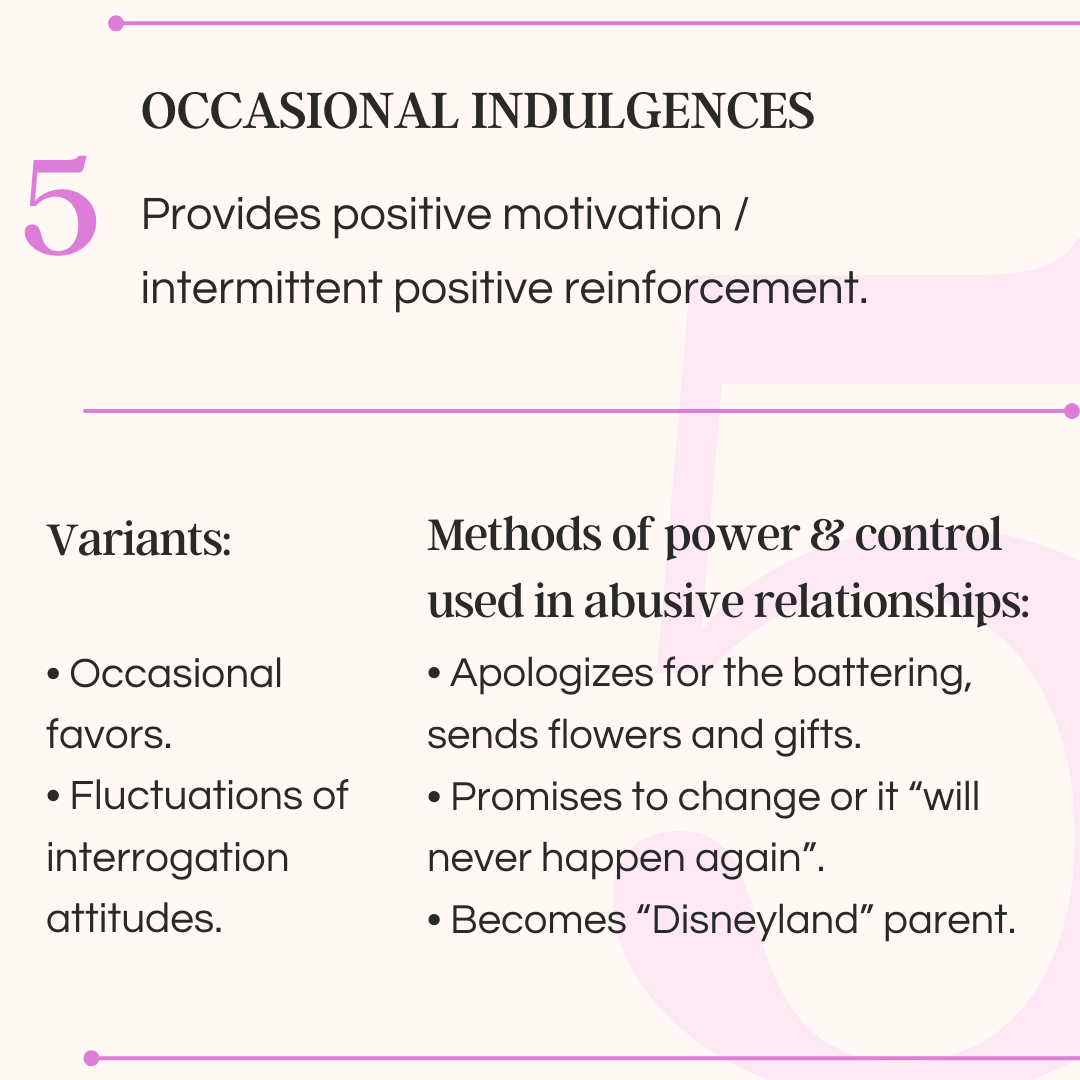
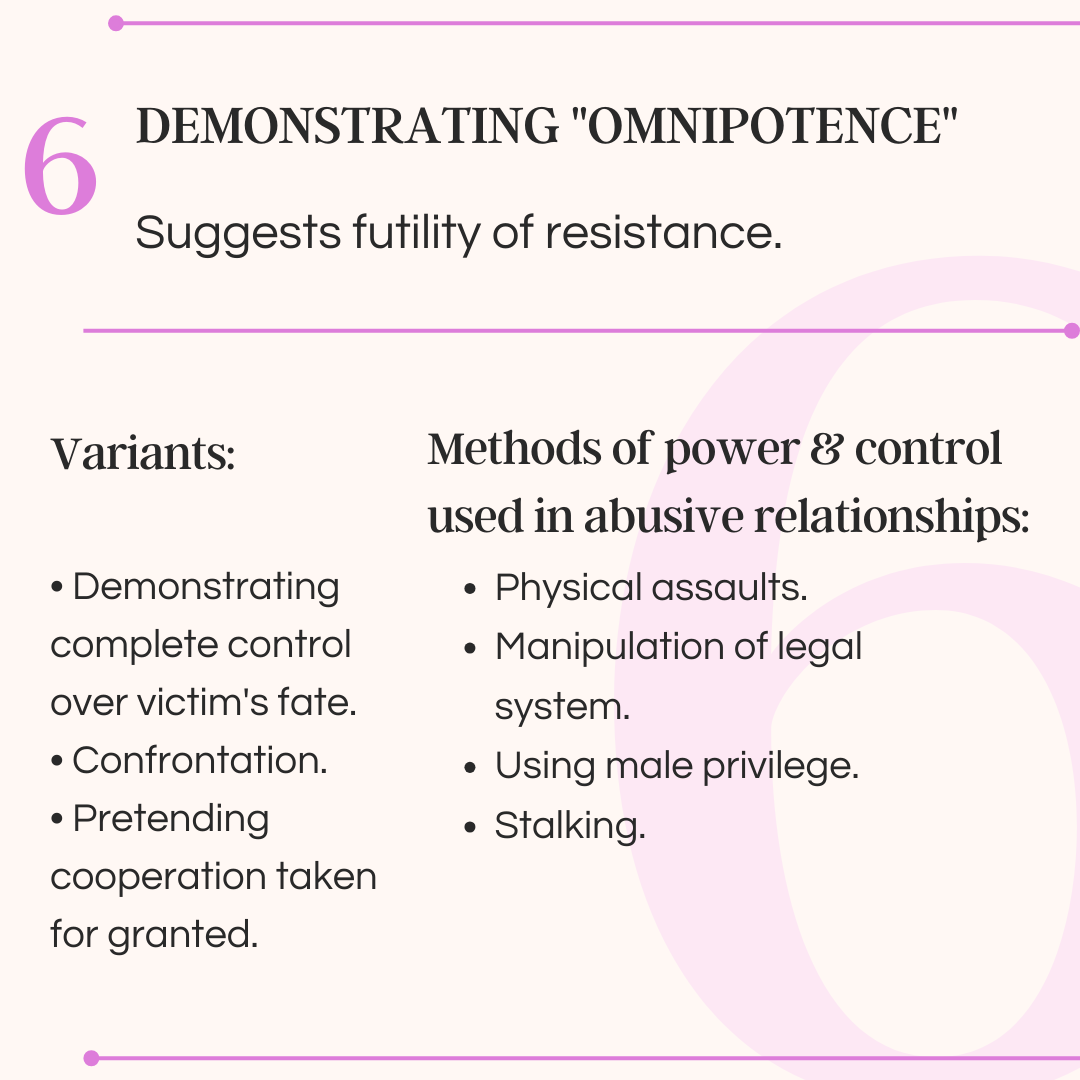
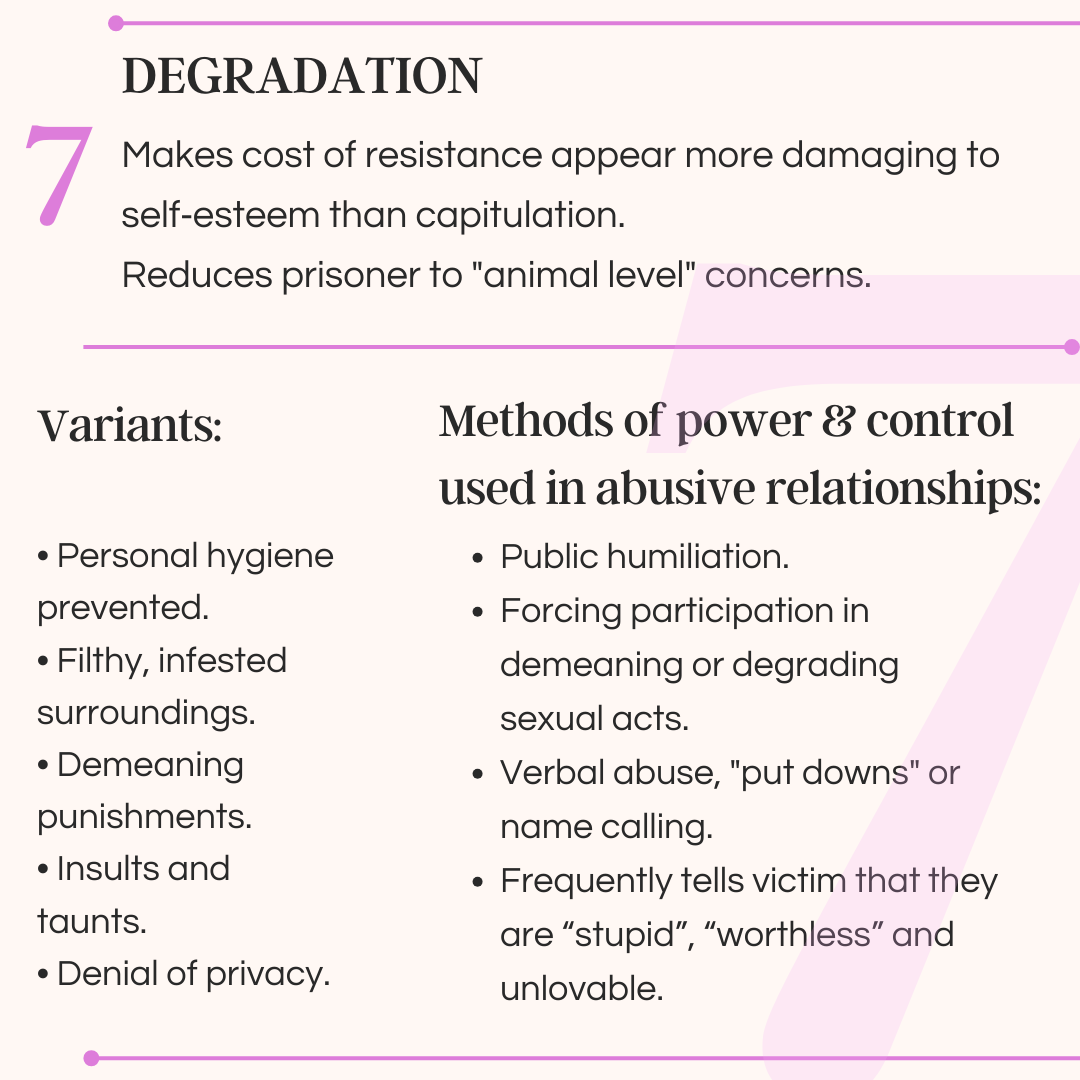
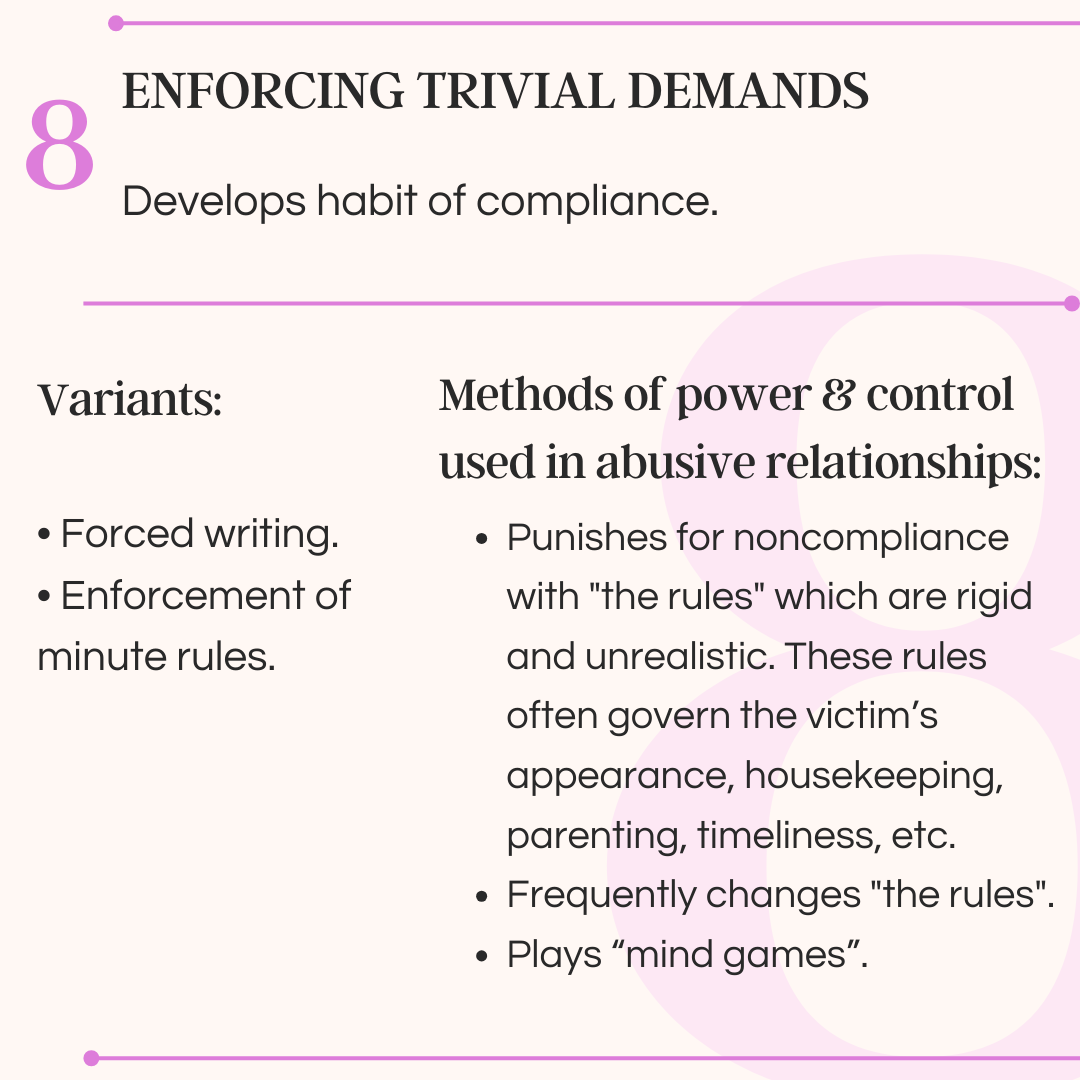
Biderman’s Chart of Coercion is a table that was originally created to describe coercive methods of torture used on prisoners of war. It describes eight tactics of psychological torment that can also be applied to the psychological abuse seen in cases of domestic violence.
Monopolization of perception is one of the eight psychological torture tactics listed in Biderman’s Chart of Coercion.

Image source: Sage Publications
The full chart lists the following methods of coercion:
Isolation
Monopolization of perception
Induced debilitation and exhaustion
Threats
Occasional indulgences
Demonstrating “omnipotence” and “omniscience”
Degradation
Enforcing trivial demands


What to expect after escaping the covert abuser
Ending a relationship with a covert abuser doesn't always mark the end of your challenges. It often opens up a new chapter with unique considerations that differ from leaving a "normal" relationship. Join Ruth Darlene, Founder and Executive Director of WomenSV, as she shares insights on what to expect and how to protect yourself after escaping a covert abuser.
In this video, Ruth Darlene sheds light on the common covert abuse tactics that abusers employ to maintain control even after the relationship ends. She emphasizes the importance of safety planning and provides practical considerations for survivors on the path to freedom.
Ending a relationship with a covert abuser doesn't always mark the end of your challenges. It often opens up a new chapter with unique considerations that differ from leaving a "normal" relationship. Join Ruth Darlene, Founder and Executive Director of WomenSV, as she shares insights on what to expect and how to protect yourself after escaping a covert abuser.
In this video, Ruth Darlene sheds light on the common covert abuse tactics that abusers employ to maintain control even after the relationship ends. She emphasizes the importance of safety planning and provides practical considerations for survivors on the path to freedom.
Leaving an abusive relationship can be a daunting journey, but remember, it's a significant step towards reclaiming your life and well-being. Don't miss this crucial discussion that can make all the difference in your path to healing and recovery. Your safety and future deserve the utmost attention. Watch this video to learn how to safeguard yourself and find the strength to move forward.

Covert abuse and coercive control in relationships: Eleni Sagredos and Ruth Darlene
In this video, Ruth Darlene and Eleni Sagredos share insights about covert abuse and coercive control in relationships. Topics include common traits of emotionally abusive relationships and how they can affect every aspect of survivors' lives, from self-confidence to future family dynamics. This conversation offers a compassionate perspective on how survivors can use the wisdom they've gained through their experiences to enjoy happier, safer and healthier futures.
Ruth Darlene, Founder and Executive Director of WomenSV, discusses the impact of subtle forms of abuse with Eleni Sagredos, a survivor, domestic violence educator and author of the book But They're So Nice: Unmasking Covert Abuse & Narcissistic People.
In this video, Ruth and Eleni share insights about covert abuse and coercive control in relationships. Topics include common traits of emotionally abusive relationships and how they can affect every aspect of survivors' lives, from self-confidence to future family dynamics. This conversation offers a compassionate perspective on how survivors can use the wisdom they've gained through their experiences to enjoy happier, safer and healthier futures.
Connect with us on TikTok and Instagram!
How to heal from covert abuse and find self-love
Join Ruth Darlene, Founder and Executive Director of WomenSV, for a discussion about how to heal from covert abuse and find self-love. In this video Ruth shares the impacts that covert abuse and coercive control can have on survivors even after an emotionally abusive relationship ends. Survivors often face a long healing journey while rediscovering what healthy love and self-love looks like, but there is always hope. Watch the video through the end to learn strategies that help to recover and start a fresh new chapter of freedom in life.
Join Ruth Darlene, Founder and Executive Director of WomenSV, for a discussion about how to heal from covert abuse and find self-love. In this video Ruth shares the impacts that covert abuse and coercive control can have on survivors even after an emotionally abusive relationship ends. Survivors often face a long healing journey while rediscovering what healthy love and self-love looks like, but there is always hope. Watch the video through the end to learn strategies that help to recover and start a fresh new chapter of freedom in life.

Teen Dating Violence: Covert Abuse and Coercive Control
Ruth Darlene, Founder and Executive Director of WomenSV, presents an introduction to covert abuse and coercive control with a focus on teen dating violence.
Ruth Darlene, Founder and Executive Director of WomenSV, presents a video introduction to covert abuse and coercive control with a focus on teen dating violence.
Education is essential to help prevent and address subtle forms of abuse such as covert abuse and coercive control. In this video Ruth shares an overview of covert abuse and coercive control with tips on how to recognize the warning signs, especially in teens and young adults. This discussion covers potential options for offering support to someone you are concerned about and concludes with a list of several available resources.
This presentation was originally recorded for the MVLA Challenge Team. The MVLA Challenge Team partners with leaders from school districts, city and county services, parent and student groups, and other non-profit organizations to support the success of children, youth and families in Mountain View, Los Altos and Los Altos Hills.

Covert abuse and coercive control discussion with Eleni Sagredos and Ruth Darlene: watch the video!
Ruth Darlene, Founder and Executive Director of WomenSV, discussed covert abuse and coercive control with Eleni Sagredos, who is a survivor, domestic violence educator and author of the book But They're So Nice: Unmasking Covert Abuse & Narcissistic People.
Watch this video to learn about common characteristics of covert abusers, early warning signs, prevention, safety considerations and how survivors can reclaim their power.
Ruth Darlene, Founder and Executive Director of WomenSV, discussed covert abuse and coercive control with Eleni Sagredos, who is a survivor, domestic violence educator and author of the book But They're So Nice: Unmasking Covert Abuse & Narcissistic People.
Watch our YouTube video to learn about common characteristics of covert abusers, early warning signs, prevention, safety considerations and how survivors can reclaim their power.
Topics:
0:00 Holidays and covert abuse
2:55 Recognizing subtle forms of abuse
11:18 How abusers choose targets
15:47 Prevention and boundaries
17:59 Early warning signs
27:06 Damage over time
34:16 Common characteristics of covert abuse
49:08 Safety and speaking out
54:46 Trusting intuition
57:26 Love bombing
1:00:05 Finding community and taking our power back
Connect with us on TikTok and Instagram!

WomenSV: Serving survivors of covert domestic violence
Help support WomenSV by making a contribution to the LATC Holiday Fund! It is through the support of community partners such as the Holiday Fund that WomenSV is able to serve survivors of covert abuse and coercive control.
Help support WomenSV by making a contribution to the LATC Holiday Fund! It is through the support of community partners such as the Holiday Fund that WomenSV is able to serve survivors of covert abuse and coercive control. For more information and to make a donation, visit the article linked below!


From Trauma to Triumph: Executive Summary Workshop Presentation at the Domestic Violence Conference
Watch as Rachel McKenzie presents "From Trauma to Triumph: Executive Summary Workshop" at the County of Santa Clara's 30th Annual Domestic Violence Conference, on behalf of WomenSV.
Watch as Rachel McKenzie presents "From Trauma to Triumph: Executive Summary Workshop" at the County of Santa Clara's 30th Annual Domestic Violence Conference, on behalf of WomenSV.
Created by Ruth Darlene, founder and Executive Director of WomenSV, the Executive Summary Workshop is a powerful tool to assist domestic violence survivors in navigating the challenging journey of summarizing their experiences in a clear and concise manner, enabling effective communication with others.
For survivors, putting traumatic experiences into words can be a daunting task, yet it is a crucial step in seeking support. Recognizing this challenge, WomenSV developed a systematic approach to assist survivors in this process.
We extend our heartfelt gratitude to Rachel McKenzie for leading this presentation, sharing valuable insights and offering unwavering support to domestic violence survivors. Together, we strive to empower survivors on their journey from trauma to triumph.
Join us in this important conversation, and together, let's make a difference in the lives of those who have endured and overcome domestic violence.
Sign up for our newsletter and view contact information to schedule a training here.
To donate and help support our mission, click here.


K-LOVE Interview with Ruth Darlene of WomenSV about Covert Abuse and Coercive Control
K-LOVE interviewed Ruth Darlene, Executive Director and founder of WomenSV about subtle forms of domestic violence including covert abuse and coercive control.

K-LOVE interviewed Ruth Darlene, Executive Director and founder of WomenSV about subtle forms of domestic violence including covert abuse and coercive control.
The radio interview is now available on our YouTube channel and on K-LOVE’s website! Check it out at the links below.

Domestic Violence Awareness Month Proclamation: WomenSV and Sunnyvale City Council
October is Domestic Violence Awareness Month, and we're proud to share that Ruth Darlene, the founder and Executive Director of WomenSV, joined the City of Sunnyvale's Council meeting to raise awareness about this important month.
October is Domestic Violence Awareness Month, and we're proud to share that Ruth Darlene, the founder and Executive Director of WomenSV, joined the City of Sunnyvale's Council meeting to raise awareness about this important month. WomenSV, short for Women of Silicon Valley, is a Bay Area nonprofit organization dedicated to empowering survivors, training service providers, and educating our community about the insidious cycle of covert abuse and coercive control in intimate partner relationships. Domestic violence knows no boundaries; it touches communities across the Bay Area and around the world. By shining a light on this critical issue, we stand together in solidarity with survivors and let them know they are never alone. 💜
Watch the recording on our YouTube channel!